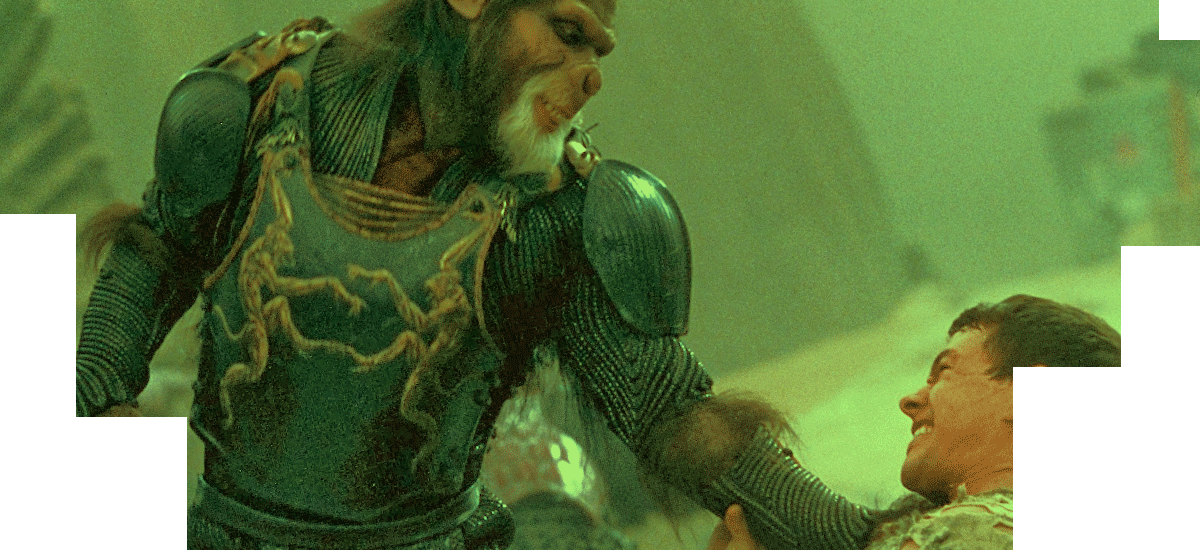
There was a 28 year gap between the last of the original Planet of the Apes movies in the 1970s and the very first remake, but I think a lot of people forget that the first remake wasn’t the fabulous Rise of the Planet of the Apes in 2011 it was instead Tim Burton’s Planet of the Apes in 2001.
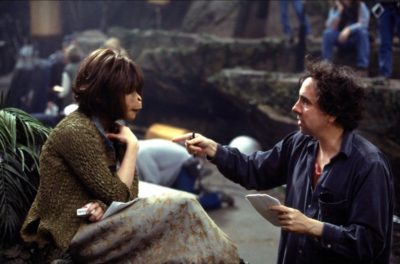
Burton’s movie was savaged by critics and fans alike, especially with its time-bending final scene that left movie goers scratching their heads as they left the theater. I didn’t much care for Burton’s Planet of the Apes the first time I saw it either — though admittedly the first time I saw it was via VHS on a little 13” TV so it wasn’t the most optimal experience to begin with. But still, after I saw Burton’s Planet of the Apes 16 years ago I never really checked out the movie again until a few weeks ago when I caught it on cable. I think watching it now without a lot of the negativity that was swirling around the movie back then let me see it in a different light. While Burton’s Planet of the Apes isn’t his best movie, it’s not the worst Planet of the Apes movie either. In fact, it’s kind’a good.
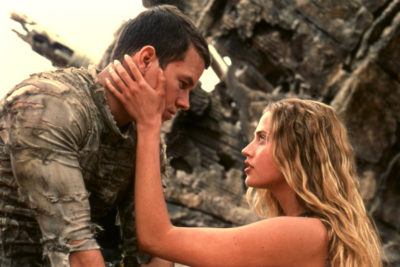 While the most recent Apes movies are sort of reverse sequels/not quite prequels to the original 1960s and 1970s movies, Burton’s Planet of the Apes is a remake of the original film. There were attempts at rebooting the Apes franchise in the 1980s and 1990s, the most famous example of which would have starred Arnold Schwarzenegger in the title role with Oliver Stone, yes, that Oliver Stone, directing. But for whatever reason it wasn’t until 2001 and Burton’s film that the apes would return to the big screen.
Here, astronaut Leo Davidson (Mark Wahlberg) finds himself marooned on a weird planet where apes are the dominant species and mankind are seen by them as pests. Davidson finds help from ape Ari (Helena Bonham Carter) who go on the run from the evil General Thade (Tim Roth) who wants Davidson dead.
Which is essentially the plot of the first 1968 Planet of the Apes movie that starred Charlton Heston, but there is one big difference here between the 1968 Apes and the 2001 version — the direction of Tim Burton.
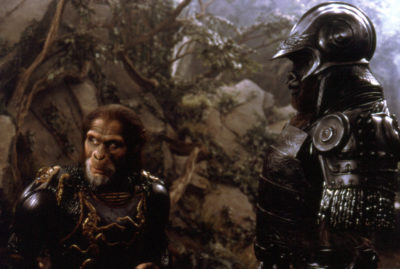 Honestly, Burton isn’t given enough credit these days for the films that he’s directed. Or, at the very least, he’ll be a director when we one day look back at his career and tremble at how good it was and how little respect he got for his work when it was released.
To name a few, Burton directed the greatest superhero film of all time Batman in a time when superhero movies were considered kid’s stuff. He directed Beetlejuice, a movie so good it’s still relatable 30 years later. And he directed Big Fish a movie I’ve only been able to stand watching once, because I’m afraid if I ever watch it again I’ll spend most of the movie lost in emotions.
Oh, and he also directed that Planet of the Apes movie too.
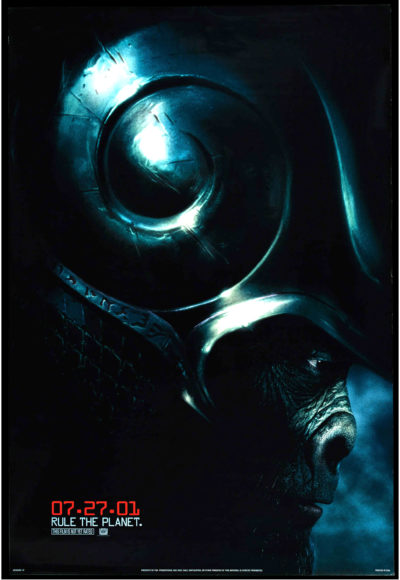 Now, Planet of the Apes isn’t Burton’s best movie, but it’s still a solid film. Plus, mostly known as a horror director, it’s one of only two sci-fi movies Burton has directed, the other being Mars Attacks. For that reason alone I think fans of the genera should have a special place in their hearts for this film. Burton’s Planet of the Apes has all his weird and wonderful stylings from the design of the apes costumes and villages to the weird and wonderful headgear the apes wear in this film.
I might have not liked the movie at the time of release but I sure did like the posters from it that focused on the style of the movie — I ended up buying several of them back then.
Burton’s Planet of the Apes never lived up to its potential and barely made back its budget at the box office. Which would mean the franchise would go dormant for another decade before it would be rebooted again with Rise of the Planet of the Apes. Now, the third movie of that series War for the Planet of the Apes is out July 14 that’s supposedly the finale to that franchise.
It might be a while for Burton to return to sci-fi. His next movie is supposed to be a live-action remake of the animated film Dumbo then Beetlejuice 2.
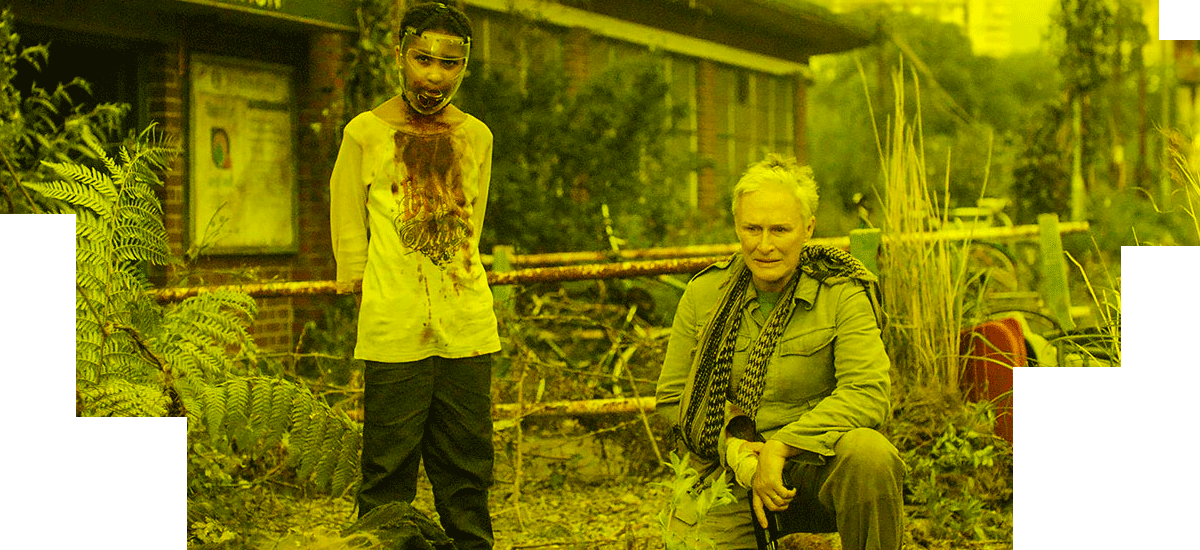
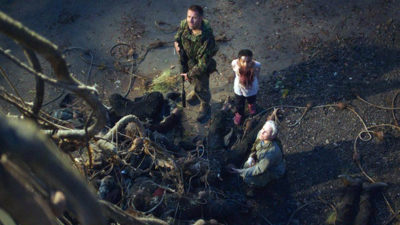 In The Girl with all the Gifts, it’s an unspecified time after a virulent fungal plague has swept the planet and turned those affected by it into green, flesh-hungry zombies. The UK military has abandoned the cities and has retreated to bases in the country in order to study the outbreak and come up with a vaccine lead by Caldwell. Enter a group of kids born after the plague including Melanie (Sennia Nanua) who have the infection but haven’t turned into blood-crazed ghouls and seem to be the key to finding a way to end the apocalypse.
 And this Caldwell/Neville character connection –– not to ruin things too much, but much like with Neville, Caldwell is so focused on coming up with a solution to reversing the apocalypse that she can’t see that a new order has started to emerge which is changing the balance of power on the planet.
 May 19 sees the release of Alien: Covenant, the third Ridley Scott Alien film, and a direct sequel to Prometheus (2012). Prometheus got a bad rap by the critics but made more than $400 million at the box office hence Alien Covenant. What’s interesting here is that from the looks of things Scott has taken Alien: Covenant back to something a little more in the vein of Alien with the crew of a ship fighting the insect-like baddies and away from the more esoteric Prometheus, which I happened to like a great deal. Luckily, I also happen to like Alien a great deal too and couldn’t be more excited for this movie if I tried.
 The creators of The Mummy on June 9 are attempting to create their own franchise and so-called “shared universe” of movies with the Universal Monsters. Starring Tom Cruise not as the mummy but someone trying to stop her from destroying the world, early looks at The Mummy seem to indicate something like Mission Impossible crossed with Suicide Squad. The Mummy is the first movie of this interconnected film universe that will also include the likes of The Invisible Man, Wolf Man, Frankenstein and the Creature from the Black Lagoon in future films if this one’s a hit.
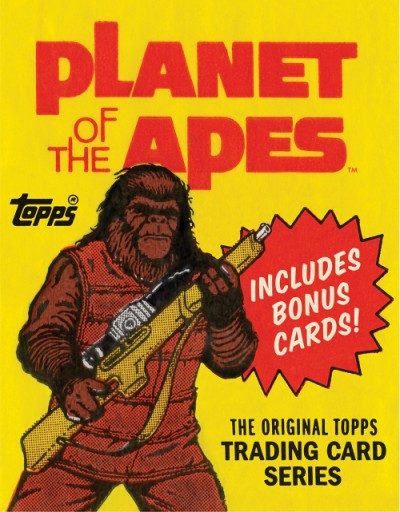
 A third Planet of the Apes film War for the Planet of the Apes is out July 14. The Apes film series is one of my favorites with the first chronicling why the apes got their smarts and the second what was happening with them just after the fall of man. This third film seems to be the story about the final apes vs man battle, with the winner taking claim to the planet. If you’ve seen the 1960s/1970s apes movies I’m sure you know how that works out.
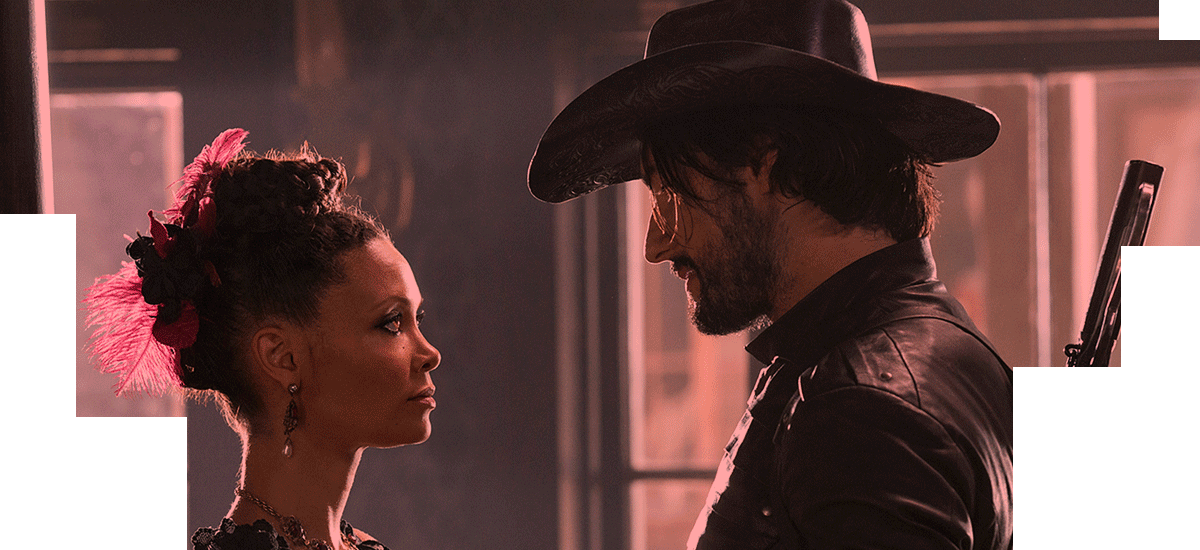
 Honestly, I wasn’t sure what to expect with Westworld but whatever I was thinking the show might be like isn’t anything as to what it actually was like. Much of the story is told via three groups of characters. The first group is of people like Dr. Ford (Anthony Hopkins) and Bernard (Jeffrey Wright) who are trying to keep this massive park running while at the same time making improvements while acting in a sort of god-like way even if some of their changes have started causing glitches in the robots of the park known as the “hosts.” These robots don’t know that they’re robots and awaken each day anew not realizing that they’re all in a story loop and essentially play the same day over and over again. With this robot group are characters like Maeve (Thandie Newton) who’s starting to have memories she shouldn’t have and Dolores (Evan Rachel Wood) who’s beginning to question the nature of her reality. And then there’s the human visitors of the park like William (Jimmi Simpson) and “The Man in Black” (Ed Harris) who are experiencing the park in very different ways. Harris’ character is convinced that there’s a core story beneath the veneer of Westworld that the rest of the guests experience and wants to uncover this truth, even if it means he has spend 30 years there and cause pain, death and destruction to the hosts to do so. And William, brand new to the park, wants to help Doloris in her quest for self realization but isn’t sure what all is required to do so or the ramifications of.