Mad Max: What a lovely day

It took me a lot of years to fully appreciate the movie Mad Max (1979). I saw that film many times on TV during the 1980s but if you would have asked me back then if I’d preferred Mad Max or its sequel The Road Warrior (1981) I would have gone with The Road Warrior every time.
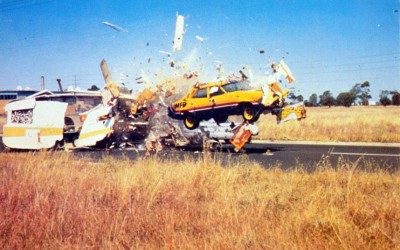
BKBKRH Film Mad MaxIt wasn’t until Mad Max was finally released on DVD in its unedited and undubbed form that I began to see the strengths that movie had and slowly began to consider it the best Max movie of the bunch.

Since the fourth Max Max movie Mad Max: Fury Road is out May 15 I decided to watch the original Mad Max again. This time through I noticed something interesting that I hadn’t taken note of before. In Mad Max there’s a long stretch of film that has almost no dialog for more than 10 minutes. Which might not sound like much but in Mad Max which on its surface seems to be nothing more than a b-grade Western with cars instead of horses it’s something special.

In Mad Max, it’s the near-future and Max (Mel Gibson) is a police officer who gets on the bad side of a gang of bikers who murders his wife and child in retribution. Max, who goes “mad” as the Australians say “crazy” as Americans do, heads off on the hunt for the gang to kill each and every one of them.
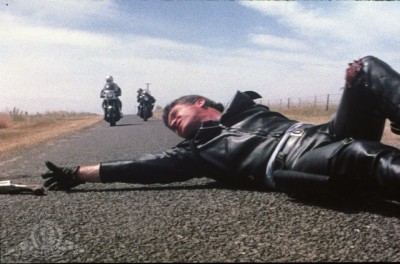
Max is run down
Max is run down

Which by all accounts is b-grade material that’s been used in loads of revenge movies/stories for years and years and years. But where Mad Max is different from what’s come before are those 10 minutes.

Over that stretch we see the bikers go about their activities bar hopping and stealing gas all the while being stalked by Max. Who eventually catches them on the open road and runs some of them down. The surviving bikers start looking for Max, ambush him and shoot him in the knee and run over his arm.

Here’s where the only bit of dialog in those 10 minutes comes in. There’s a total of nine words spoken between the two biker leaders as Max lays helpless on the road:

Toecutter: “Quit toying, Bubba.”
Bubba: “Easy, I know what I’m doing.”
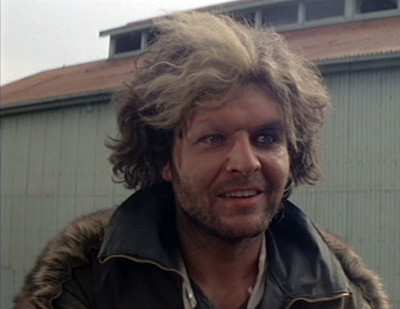
The Toecutter
The Toecutter

And that’s it. Max gets the upperhand, kills Bubba and in a spectacular real-life stunt chases the Toecutter with his car mere inches from the back wheel of the bike as the two scream down the road. Eventually the Toecutter crashes and is killed by a semi.

Then Max goes off to find the last member of the gang Johnny the Boy in a final scene that’s back to dialog.

But those 10 minutes are something to behold. It seems today that every movie, be it action or otherwise, is chock full of dialog. And it’s easy to see why. It’s simpler for a character to tell the audience what’s going on (“We need to go over there!”) rather than showing them doing it. And with movies that have a lot of story this is an easy way to save time.
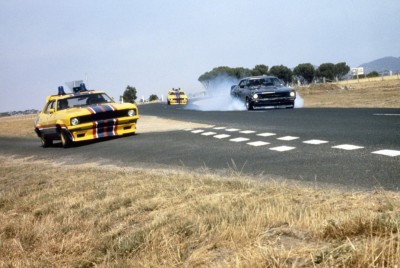
A chase in Mad Max
A chase in Mad Max

Where this technique goes askew is with modern action movies that are so complex the characters need to literally tell the audience what’s going on to keep them from becoming confused as to what’s happening on-screen. Things are exploding and there’s heroes fighting here and villains fighting there. And if someone’s not telling the audience what’s occurring it all becomes a mess and the viewers can become lost.

When I wanted to become a comic book artist I once read an article that recommended watching movies with the sound off. It said that if you can understand what’s going on with without dialog then the writer/director’s done their job well.

Which is what I thought about the last time I watched Mad Max. This whole 10 minute chunk of the movie plays out perfectly well with perfect visual clarity. There’s not a question as to what’s going on or why Max is going after these guys on screen. I was never confused as to what was going on and any extraneous dialog would have added nothing to the scene.
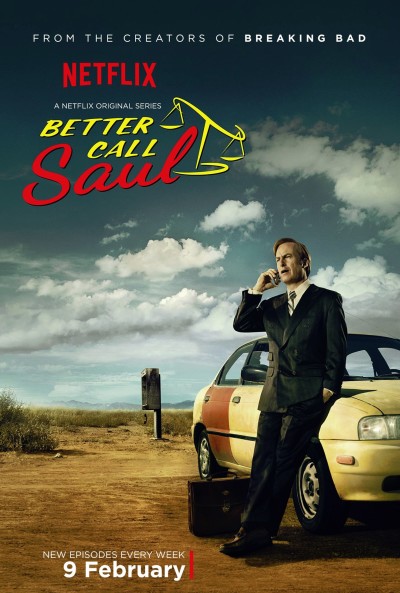
Better Call Saul

I’m obsessed with the TV series Better Call Saul at the moment. Though it ended its first season run a few weeks back I’ve been thinking about it ever since. I really think it’s (so far) the best series of 2015.

Better-Call-Saul-UK-PosterWhat’s odd about it is that I was never one who was able to get into the TV series Breaking Bad of which Better Call Saul is a prequel/spinoff. When Breaking Bad was on I’d try to watch it at the start of every new season and have tried several times to get into it via Netflix abet without success. The last time I tried to watch it I was able to get about halfway through the second season before finally giving up on it once again.
I think what bothers me most about that show is its tendency of having everything that could go wrong with something going wrong. It seems whenever the characters go to do something illegal their woes multiply; be it trying to break into a junkyard and falling into a port-a-john, going to confront someone but only finding their kids home, making meth in the desert but getting stranded stranded there when their car breaks down…

These “woes” are almost comical and really added a weird tone to Breaking Bad. It’s almost like the gods were trying to stop Walt and Jesse from doing bad things but they ignored this higher power at every opportunity.

That doesn’t seem to happen in Better Call Saul. Things go wrong for characters on that show but I never got the feeling that the writers were intentionally loading up these wrongs to add weight to what was going on with the characters.

And the thing is that the same person who created Breaking Bad (Vince Gilligan) also co-created Better Call Saul (Vince Gilligan and Peter Gould), yet I dislike one show yet love the other.

I don’t get that myself.

Online TV series are old hat

We live in a world where new TV series are being created not only by network and cable channels but via online services like Netflix, Hulu and Amazon as well. What’s amazing is that all this — from the creation of shows to how we consume content via our TVs, tablets, smart-phones, game systems, etc., etc. — has all come about in the last decade.

However…

My question is if the way we consume TV entertainment is radically different than it was 10 years ago, then why are these series that are create specifically for these online services structured the same way and have all the same restraints that traditional series do too? What I mean by this is that most network and cable produced dramas are about an hour long and comedies about 30 minutes long. These shows have credits at the beginning and endings of episodes and series seasons last between 10 and 24 episodes depending on the show.

Which structurally is mirrored by the online shows too when they don’t have to.

The idea that a show has to be either 60 or 30 minutes long is one born of the early 20th century that’s still used today. It’s a way to fit single episodes neatly into a specific time-slot where shows begin and end at the top and bottom of the hour for scheduling purposes. And the beginning and ending credits of shows are there to let viewers know that what they’ve just watched has ended and something new is about to start.

But none of this stuff is really needed for shows that we watch online.

Opening credits are redundant when I’m the one choosing what to watch. Do I really need to know that I’m watching House of Cards when I’m the one who clicked to watch that exact show in the first place? That information, opening credits specifically, just aren’t needed on online shows.

And shows being either 30 minutes long or 60 is redundant as well. When I first heard that Netflix and Amazon were working on original programming I got excited to see just what they were going to do differently with the format. The sky was the limit for how they could “play” with the medium since the shows would no longer have to be formatted to fit into a particular schedule anymore.

If a series creator wanted an episode to be 15 minutes long then why not? Or what about an episode being six hours long too? Any limit given to an online series would be an self-imposed one since it’s the user who decides to watch a given show rather than a given show airing at a particular time and filling a particular slot.

No one tells book authors how long their chapters have to be, yet with all of the online shows that I’ve watched with big names attached they’ve all been essentially network format shows that just so happen to be online. I guess on one hand this makes sense. Creators are used to making shows a particular way, in a particular format that are a certain length and that have beginning and ending credits.

But almost none of this, except end credits, is necessary with the online series.

I’m really interested in the next filmmaker* who figures out a way to do something new and unique with the online format that couldn’t be done via traditional TV. It’s like when feature films first started being created and the stories that were originally told in that medium were staged* and shot to look like a stage play since that’s what they were used to back then.

It took some true visionaries to realize the possibilities that film allowed them that hadn’t been done before turned the medium from something old to something new and modern. I think that same sort of thing needs to happen to the online series too.

Right now while the quality of some of those shows might be spectacular, structurally they’re old. And when some talented filmmaker comes in and takes the online format to the next level that’s when things will really start to get interesting in the online space.

*Using old words to describe something new.

Visit me online at DangerousUniverse.com.